A Beachcombing Checklist for Reading the Shoreline
Use this beachcombing checklist to sort shells, sea glass and drift finds by type, record useful details, and decide what to leave on the shore.
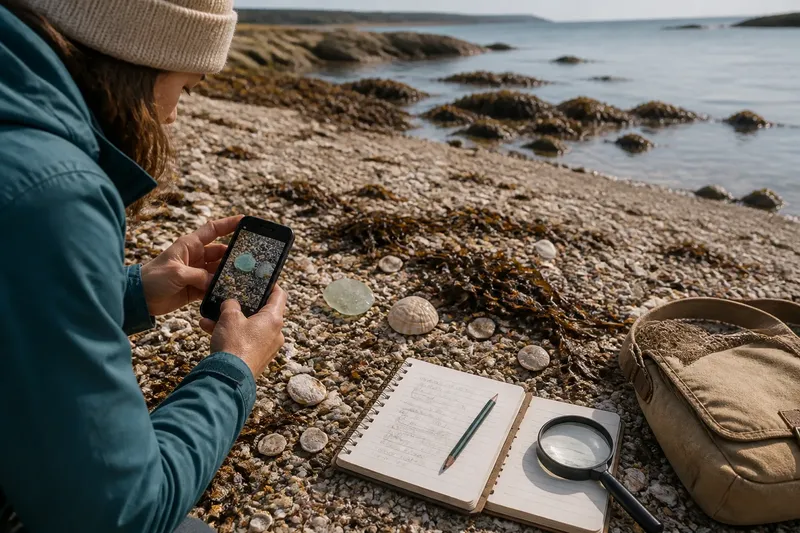
You spot a green glass fragment beside a striped shell, then notice a tangle of weed caught in the shingle. A beachcombing checklist can help you identify what you are seeing and make a sensible decision about it, rather than turning every find into something to collect.
Pack for identification
Take a small notebook and pencil, or use your phone to photograph finds where they lie. A compact hand lens can help with surface details, but do not pick up an object just to inspect it. Leave collecting bags at home so they do not make taking things feel like the purpose of the walk.
Use this checklist as you scan a patch of shore. Each observation points to a practical next move:
- Check the material: If a find looks like shell, stone, glass, bone or plastic, note its appearance and leave it in place; if you cannot identify it, do not handle it and record a description from a safe distance.
- Check the setting: If it lies among living weed, in a rock pool or near an animal, leave the whole area undisturbed; if the spot is clear and stable, observe without shifting anything.
- Check for sharp edges: If glass or metal appears jagged, do not touch it; if it is clearly litter and you can remove it safely with suitable protection, follow local guidance, otherwise leave it and alert the site manager.
- Check for wildlife: If an animal is attached to, sheltering under or resting beside an object, keep your distance; if no wildlife is visible, still avoid turning the object over.
- Check local notices: If signs restrict collecting or access, follow the stated boundary and leave natural material in place; if the rules are unclear, choose observation only.
- Check your record: If a photograph shows the object and its surroundings clearly, save it with a brief location note; if it does not, make a short written description instead of repeatedly approaching or disturbing the find.
For any uncertain material, avoid touching it, especially if it could be hazardous or biologically important. Site notices and local authorities are the right source for rules that apply to a particular beach.
Sort finds by type
Start with broad categories rather than trying to name every specimen. Shells may show ridges, hinges or a spiral; pebbles vary in colour, grain and rounding; sea glass tends to have softened edges, while broken glass can remain sharp. Driftwood can carry marks from water and weather, but a similar-looking fragment may be manufactured material.
Notice the difference between a natural object and litter without using touch as your test. If appearance alone does not settle it, record it as unidentified. That is a useful result: it prevents a guess from becoming a reason to take or handle something.
Say you find a pale, frosted fragment among shells and shingle. You photograph it where it lies, note that it has rounded-looking edges, and leave it in place. The image gives you a record to compare later, while the cautious description avoids treating an uncertain material as definitely sea glass.
Read the surface
Look for details that help distinguish objects: a shell’s growth lines, a pebble’s speckles, the cloudy surface of a glass-like fragment, or the fibres in a piece of wood. A hand lens can make small features easier to see without requiring you to lift the item. Keep it brief if getting closer would mean stepping onto unstable ground or crowding wildlife.
Record only what you can actually see. “Pale, curved, ridged” is more useful than a confident species name based on a glimpse. A pencil sketch can capture an outline; a phone photograph can include nearby material for context.
Notice where finds gather
Beachcombing is also about location. Shells and small stones may gather along a visible line, while weed and drift material can collect where the shore changes shape. Watch from stable ground and note whether the objects are scattered, clustered or caught against a natural boundary.
Do not move driftwood, turn stones or pull weed aside to see what lies beneath. These places can shelter small animals, and rearranging them changes the scene you are trying to understand. If a patch is inaccessible or unstable, leave it out of your search.
What should you record?
How do I identify sea glass?
Look for a glass-like surface and edges that appear softened, but treat visual identification as tentative. If you are unsure, write “possible glass” and leave the fragment where it is.
Should I pick up shells?
Check local rules first, since restrictions vary by site. When rules are unclear, or a shell is occupied, attached to weed or near wildlife, leave it in place and make a note instead.
What should I do with a sharp-looking find?
Do not handle it to confirm what it is. If it seems to be hazardous litter, contact the beach manager or follow local instructions; only remove it if it is safe to do so and the site guidance allows it.
Leave uncertain finds
There is little value in chasing a flawless shell, taking repeated close-up photographs or carrying a specimen away before you know what it is. A quick description and a clear record are usually enough for a curious walk; spend the saved attention on a different patch of shore.
Before you leave, check that your notebook, phone and other belongings are with you, and take away any litter you can safely handle under local guidance. For beachcombing, a useful checklist does more than catalogue objects: it helps you distinguish what you can observe from what is better left untouched.