Before the Souvenir Stall: The Story of the Seaside Postcard
Seaside postcard history shows how a picture and a short note turn a coastal view into a personal keepsake, and offers clues for reading old cards.
A postcard rack beside the promenade offers a row of piers, harbours and beaches in miniature. Seaside postcard history begins with that simple pairing: a printed view on one side and space for a message on the other, bringing a place to someone who was not there.
The card’s role changed with postal habits, printing and holiday travel. Rather than treating every old card as evidence of a single timeline, read its format, image and marks as clues to how people used it.
Cards for brief messages
Postal cards offered a direct alternative to a sealed letter for short notes. A sender could write a greeting, address the card and post it without preparing a separate envelope. The open format made the exchange convenient, but it also meant the message was visible in transit.
Illustrated cards added a picture to that practical format. The image might identify a harbour, pier, promenade or stretch of sand, while the writer supplied a personal detail. The picture did not need to tell the whole story; it gave the recipient a quick sense of place.
Postal rules and card layouts varied across periods and places. A divided back, a stamp and a postmark can help identify how a particular card was prepared and sent, but one card alone cannot establish when a format became common everywhere.
Seaside scenes in print
Coastal towns offered printers and sellers recognisable subjects: piers, bathing machines, boats, seafront buildings and busy beaches. Illustrated cards let visitors take a portable image home, while a familiar landmark helped a recipient identify the destination.
A card could also promote a resort, though it is safer to describe the image than to assume what a printer intended. A view of a pier may make the structure the focus; a crowded promenade may emphasise activity. Neither scene captures every part of a visit.
When reading an old card, distinguish what is visible from what you infer. A caption may name a town without locating the exact viewpoint. A clear image of a building can support an observation about its appearance, but it cannot by itself tell you how visitors felt about the place.
Image, message and privacy
A postcard could suit a brief holiday update: a greeting, a note about a walk or a mention of something the sender had just seen. The image supplied context, so the writer did not have to describe every detail.
Because the message travelled openly, it was a poor place for private or delicate news. Keep that distinction in mind when interpreting an old card: a cheerful greeting may reflect the limits of the format, not a complete account of the sender’s circumstances.
What can an old card tell you?
What does the picture show?
Name the visible subject first: perhaps a pier, harbour entrance or row of beach huts. Then note what the frame excludes, without assuming the omitted area was empty or unimportant.
Can the caption locate the view?
A place name can identify a town or resort, but it may not pinpoint the photographer’s position. Compare the caption with visible landmarks before making a more exact claim.
What can a postmark establish?
A legible postmark can indicate that the card passed through the postal system at a particular place and time. It does not necessarily show when the picture was taken or when the card was printed.
What do the reverse and message add?
The layout, address, handwriting and message show how someone used the card. Folds or fading show physical handling, but do not identify who kept it or why.
Reading the details
Use the card as a small historical object, not as a complete account of a holiday. Check each feature and let the evidence guide the next decision:
- Viewpoint: Observe which landmark or activity sits at the centre; if the frame hides the surrounding area, describe only the visible scene, otherwise note the wider details that can be seen.
- Caption: Observe whether it names a town, building or beach; if it gives only a broad place name, avoid claiming an exact location, otherwise compare the named feature with the image.
- Message: Observe whether the writer mentions weather, travel or company; if the note is brief, treat it as a greeting rather than a full account, otherwise quote its specific detail in your own description.
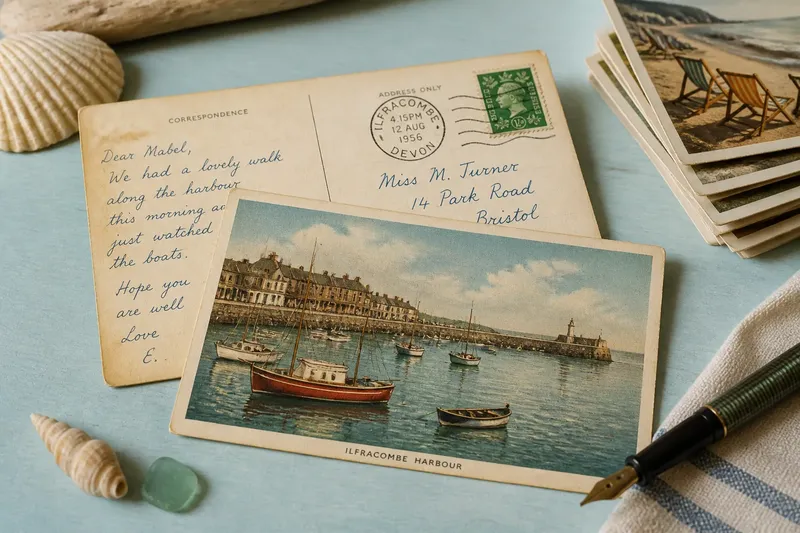
- Postmark: Observe whether the place and date are legible; if either is unclear, leave that point unresolved, otherwise record what the mark itself says without treating it as the image’s date.
- Address: Observe whether both destination and sender’s location are present; if the sender’s location is absent, do not infer it from the destination, otherwise distinguish the two when describing the card’s route.
- Reverse layout: Observe how the space is divided between address and message; if the layout is unfamiliar, describe it without assigning a date, otherwise compare it with another card only as a possible clue.
- Condition: Observe folds, fading and marks; if a feature obscures writing or an image, keep your reading tentative, otherwise describe the visible wear without assigning it a cause.
Say you have an invented card showing a harbour, with a caption naming a seaside town, a readable postmark from that town and a message saying the sender had just watched the boats. First, record the visible harbour and the caption without claiming an exact viewpoint. Next, note the postmark as evidence of where and when the card entered the mail, not when the photograph was made. Then use the message to say what the sender chose to share. The resulting account is specific—a harbour view, a named town, a postal mark and a brief personal note—while leaving the image’s date and the rest of the visit unknown.
Why keep the card?
A postcard joins a printed scene to someone’s handwriting. A blank card preserves an image; a posted one can also retain a message, an address and traces of its journey. Those elements make each surviving copy a particular object, even when the view appeared on many cards.
It is not worth trying to reconstruct an entire holiday from one flattering picture or a few lines of text. Keep the distinction between what the card shows and what you imagine: that restraint makes the details it does preserve more useful.
Choosing a card to send
Choose an image for the person receiving it, not just the best-known landmark. A familiar pier can make the location clear; a quieter harbour or a detail from your walk may feel more personal. Check that the reverse leaves room for your note.
Write one concrete detail about why you chose the card. Keep private information off the open message, and check current postal guidance for the destination before sending it.
Seaside postcard history is most tangible in the small choices the card preserves: the view selected, the words written and the route marked on the reverse. When you handle an old one, separate those visible clues from assumptions; when you send a new one, give its recipient a detail that belongs to your own visit.