The Shoreline as a Patchwork: Reading Sand, Shingle and Rock
Read a shoreline’s sand, shingle and rock through colour, texture and transitions, with a simple way to notice patterns without disturbing them.
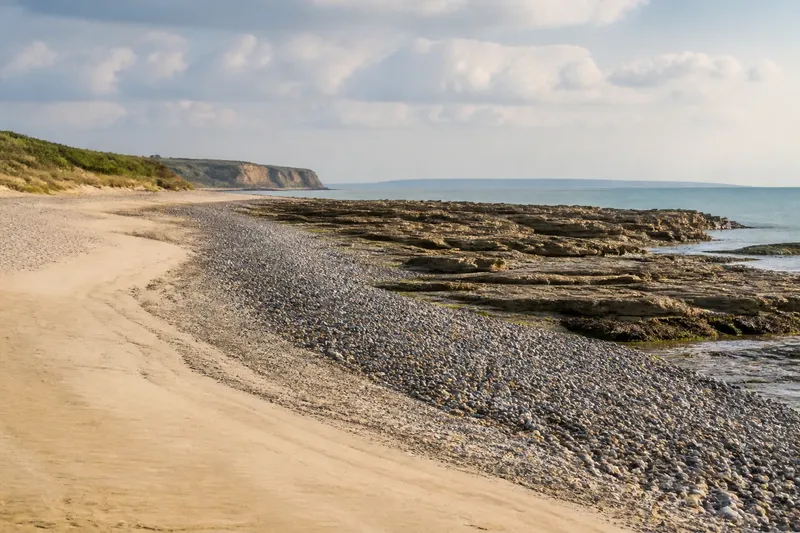
On a quiet beach, a pale ribbon of sand may end abruptly at dark pebbles, with a shelf of rock beyond. That small change is the shoreline’s patchwork: sand, shingle and rock each give a stretch of coast its own look and feel. You can read the pattern by walking and looking, without picking anything up or shifting what the tide has placed.
Start with the surface
Sand makes a shore appear soft and open. Its grains can look almost uniform from a distance, yet colour shifts reveal changes in the material: a warm band near a dune, a grey strip closer to the water, or darker grains gathered in shallow runnels. Notice where the colour changes, then look for a boundary in the slope or dampness.
Shingle gives a different impression. Pebbles catch the light individually, so a beach may look speckled, glossy or muted depending on their colour and whether they are wet. The surface often feels visually restless, even when the stones lie still. From a distance, note whether the pebbles form a narrow ridge, a broad apron or a strip between sand and rock.
Rock creates firm lines and larger shapes. A ledge can divide the beach into separate-looking sections, while scattered boulders make a looser pattern. Look for cracks, shallow hollows and pale marks left by water. Keep your attention on visible features rather than stepping onto slippery or exposed surfaces.
Watch the transitions
The meeting points are often more revealing than any single material. Sand may taper into shingle; pebbles may gather against a rock ledge; a thin seam of finer grains may lie between larger stones. These edges can be sharp or blurred, and their shape gives the beach its visual rhythm.
Choose one boundary and follow it with your eyes along the shore. Does it run straight, curve around a boulder or break into small patches? Check whether it sits high on the beach or close to the water. You are observing where materials lie, not trying to infer a precise cause from one glance.
Nearby land can add another layer. A stream may leave a darker trace across sand; a cliff or harbour wall can cast a shadow that changes how the surface reads. Treat such details as part of the scene, while keeping the main question simple: where does one shore material give way to another?
Read colour and texture
Colour is easiest to compare when the light is steady. A cloud passing overhead can make wet pebbles brighten or turn a rock face flat, so pause before deciding that a band has changed. Compare surfaces at roughly the same distance from the water, where dampness is less likely to be the only difference.
Texture also changes with viewpoint. From above, a shingle ridge may seem smooth; from a safe, dry position, the individual stones become clear. Sand can look featureless until a shallow groove or a line of tiny ripples catches the light. Rock may appear plain from afar but show a network of cracks when seen closer.
Use a small visual vocabulary rather than trying to name every grain or stone. Try “fine”, “coarse”, “smooth-looking”, “broken”, “pale” or “dark”. These are observations, not identifications, and they are enough to compare one patch with the next.
A simple shoreline scan
For a quick field note, pick a safe place with a clear view and use the same sequence each time:
- Mark the scene. Note a fixed landmark, such as a groyne, headland or path down to the beach.
- Find the main materials. Look for sand, shingle and rock, including places where one is absent.
- Trace one edge. Follow a visible transition and describe whether it is straight, curved, broken or patchy.
- Compare colour and texture. Look for one clear contrast, such as pale sand beside dark pebbles.
- Notice the shape. Record whether the material forms a ridge, flat band, slope or scattered cluster.
- Leave the surface as it is. Keep the note in words or a sketch rather than moving stones, scraping sand or collecting fragments.
A few words are enough: “dark shingle, narrow ridge, curved edge beside pale sand”. If you return later, use the same landmark and description style. You can then notice visible differences without assuming that every change has the same explanation.
What does a dark band mean?
Is dark sand a different material?
It may be, but colour alone cannot settle that. Wetness, shade and naturally darker grains can all affect what you see, so compare the band with nearby surfaces in similar light.
Why do pebbles gather in a ridge?
A ridge is a shape worth recording, not a complete account of how it formed. Note its position and outline, then leave the explanation open unless you have reliable local information.
Can I compare the same beach on different days?
Yes: use a fixed landmark and note the visible state of the shore, including whether the surface looks wet or dry. A changed pattern is an observation; it does not by itself reveal what caused the change.
Do I need to identify every stone?
No. For reading the shoreline’s patchwork, broad descriptions of colour, size and arrangement are more useful than uncertain names. A field guide can help if identification is your separate aim.
Keep the looking light
A phone photograph can help you remember a pattern, but it is not essential. Take it from a stable place, frame the boundary and include a landmark for context. A quick pencil sketch is often clearer than a close-up because it shows how the materials sit beside one another.
What is not worth the effort is turning a quiet observation into a search for a perfect explanation or a complete inventory. Shore surfaces are varied, and a brief note can still capture their character. Leave shells, stones, seaweed and any living shore life where they are; the point is to notice the arrangement, not improve it.
Next time you cross from sand to shingle or see a rock shelf interrupt a smooth beach, pause at the edge and describe its line. That simple habit makes the shoreline’s pattern easier to see, while keeping the patchwork intact for the next person.